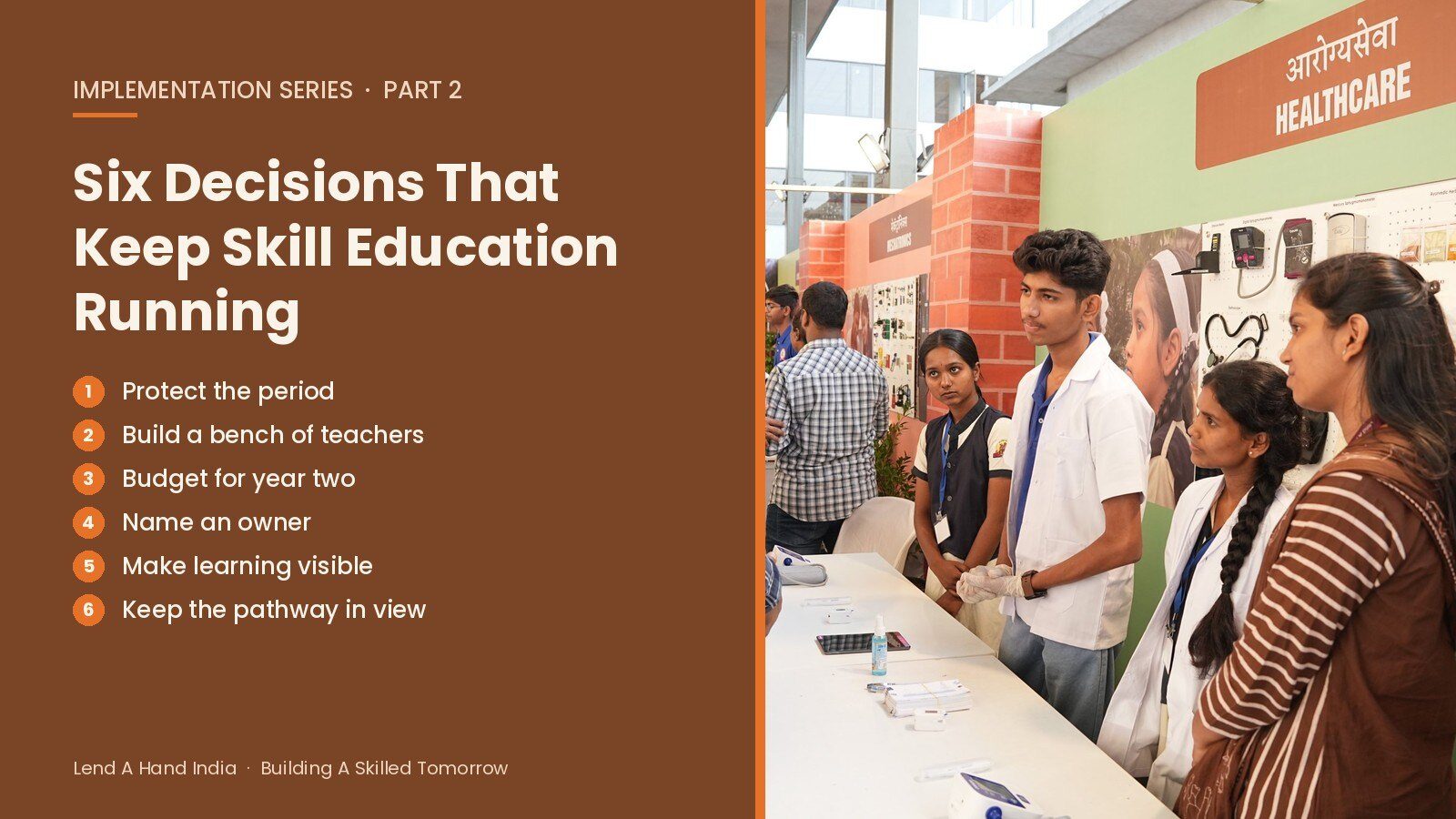
The year-two problem
Most conversations about skill education implementation in schools focus on the launch: the lab, the equipment, the first exhibition. The harder test comes a year later.
Picture a school at the start of its second year of skill education. The timetable is tighter than it was last year. One of the trained teachers has moved to another role. Consumables bought at launch are exhausted, with no clear ownership for replenishment. The programme has not been cancelled. It has simply become the easiest thing in the school day to postpone.
Many principals will recognise some version of this. Skill programmes rarely fail with a bang. They fade quietly, once the early energy has settled and they must compete with everything else the school does.
This article looks at why that happens, and why it has little to do with commitment. To get there, we first look at what applied learning gives students, and then at the four places where a programme quietly starts to slip.
Why applied learning is worth sustaining
Applied learning means students use what they learn: they make, test, repair, measure and present something, and then reflect on it. For students in Classes 6 to 10, it enables children to experience what they learn in science, mathematics and social science, and builds critical thinking, problem-solving and communication along the way.
For a principal, the practical question is therefore not only “what must we do?” but “what do we want our students to gain, and can we deliver it reliably?” The policy gives direction. The school's own design decides whether students actually experience it.
The benefit of applied learning only shows up if the programme lasts. That is why sustaining matters as much, if not more, than starting. A programme that runs for a year and then shrinks gives students a taste of applied learning and takes it away.
Four areas where programmes break down
The patterns below are the ones that, in our experience, built over 20 years of skill education in more than 20,000 schools, most often explain why a skill programme loses momentum.
1. The timetable erodes. Skill periods are often the first to be swapped for exam preparation, rehearsals or substitution cover. What it costs students: Practical work depends on continuity. A project that is started one week and interrupted for the next three loses its thread, and students quietly learn that this subject matters less than the others.
2. The trained teacher leaves or is redeployed. One teacher carried the programme, and when they move, so does the capability. What it costs students: The class continues, but with someone who has not been prepared to facilitate hands-on work, lessons slide back into reading from a book or watching a demonstration.
3. Materials and consumables run out. The lab was budgeted as a one-time purchase. Year two has no allocation for consumables or repairs, so activities shrink to demonstrations. What it costs students: They watch instead of doing, which defeats the purpose of the space.
4. Nobody owns it, and nobody looks at it. The programme sits outside the academic review cycle, and no one can say what students are learning. What it costs students: Problems stay invisible until the programme has already weakened. Students and parents may also begin to see skill education as separate from “real” academics, and interest drops.
A quieter risk. A programme can keep its period, teacher and materials and still teach little, when sessions become activities to complete rather than questions to investigate. Students make things but cannot explain what they learned. What it costs students: the time is spent, but the thinking that makes applied learning worthwhile never happens.
What these four have in common
Each one depends on a decision that was made once, at launch, and never renewed. The timetable slot was agreed in year one. The teacher was trained in year one. The budget was approved in year one. Nobody was named to keep checking.
But there is good news, because the above means the problem is not a lack of commitment or capability. It is a design gap, and design gaps can be closed. In the next article, we look at the decisions that sustaining schools make early and then protect.
Read next: What the Schools That Persist Do Differently
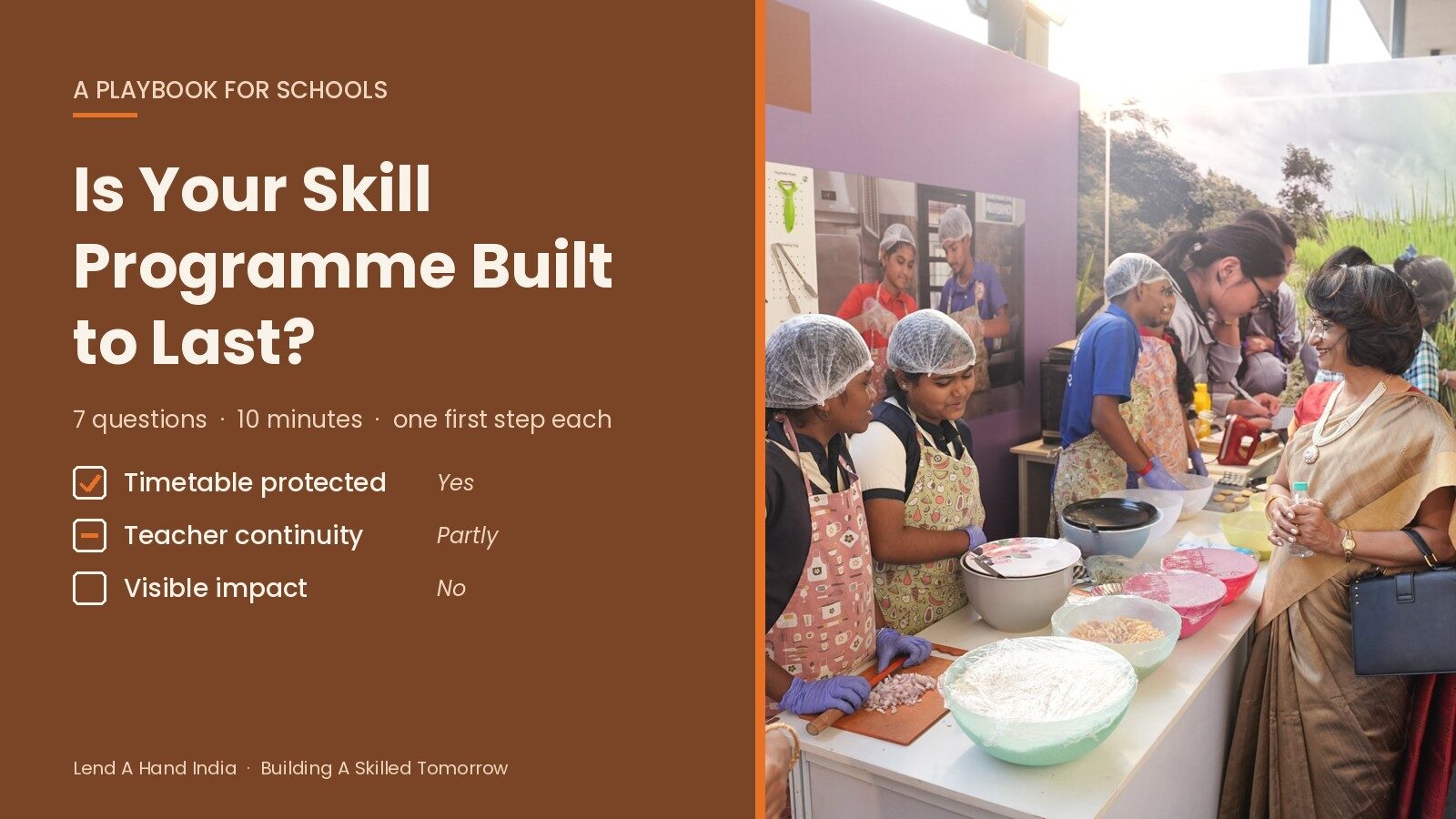
Want to check your own school first? Playbook and checklist takes about ten minutes.
How Lend A Hand India supports schools
We work with private schools to build skill education they can sustain on their own. Our work includes:
- Teacher training for Kaushal Bodh, Kaushal Vikas and other skill modules, to prepare your own teachers to facilitate practical work.
- Composite Skill Lab setup, planning space, equipment and use together.
- Karigar School of Applied Learning, with exposure visits and learning programmes for students and teachers.
- Skills on Wheels, our mobile skill lab.
- Internships for school students.
If you would like to talk through where your own programme stands.